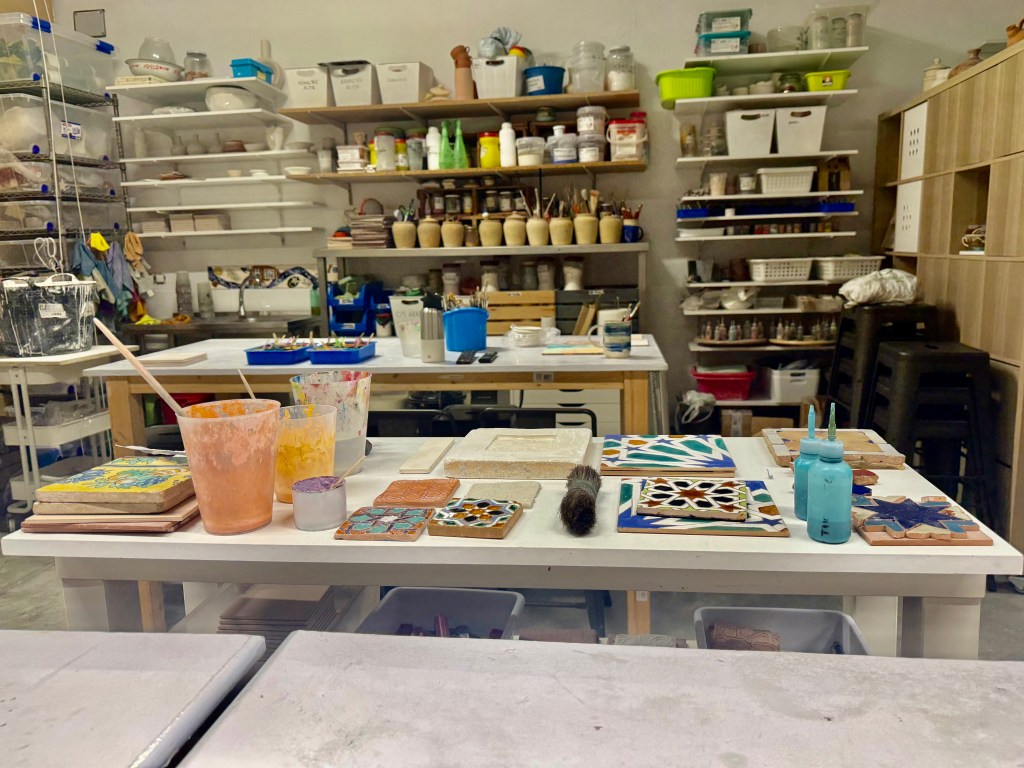
This week, I broke my pattern of revisiting old favorites in Seville. I got my hands dirty at BarroAzul Cerámica, taking a workshop that was both informative and genuinely fun. BarroAzul is housed in Triana, in a space where ceramics have been made for more than two centuries, and the workshop focused on understanding the distinctive tiles that appear on so many of the city’s walls.
Ceramics have shaped Seville’s visual identity since at least the Middle Ages, influenced by the city’s long Islamic past and later transformed under Christian rule. Triana, just across the Guadalquivir River, became the heart of ceramic production, renowned for its azulejos—glazed tiles that blend Moorish geometry with Christian imagery. With easy access to clay, river transport, and steady noble, royal, and ecclesiastical patronage, Sevillian ceramics once spread throughout Spain and beyond.
Over time, artisans developed a range of techniques. In the workshop, we were introduced to several:
- Cuerda seca (“dry rope”): A design is drawn on the tile using a greasy, manganese-based mixture, though a simple pencil can work. The oily line acts as a barrier, preventing glazes from bleeding into one another.
- Relief: A mold creates raised outlines in the clay, forming borders that hold the glazes in place. In the kiln, everything melts into a smooth, unified surface.
- Pisano: Color is painted delicately onto an already glazed white tile using a watercolor-like technique before firing. Introduced to Seville by Francisco Niculoso Pisano in the late fifteenth century, it seems engineered to expose my shaky brush control.
- Alicatado: The most demanding technique, this style involves glazing clay in different colors, cutting it into shapes—stars, diamonds, squares, and more—and assembling them by hand into geometric patterns. Clay is added to the back for reinforcement before a second firing.
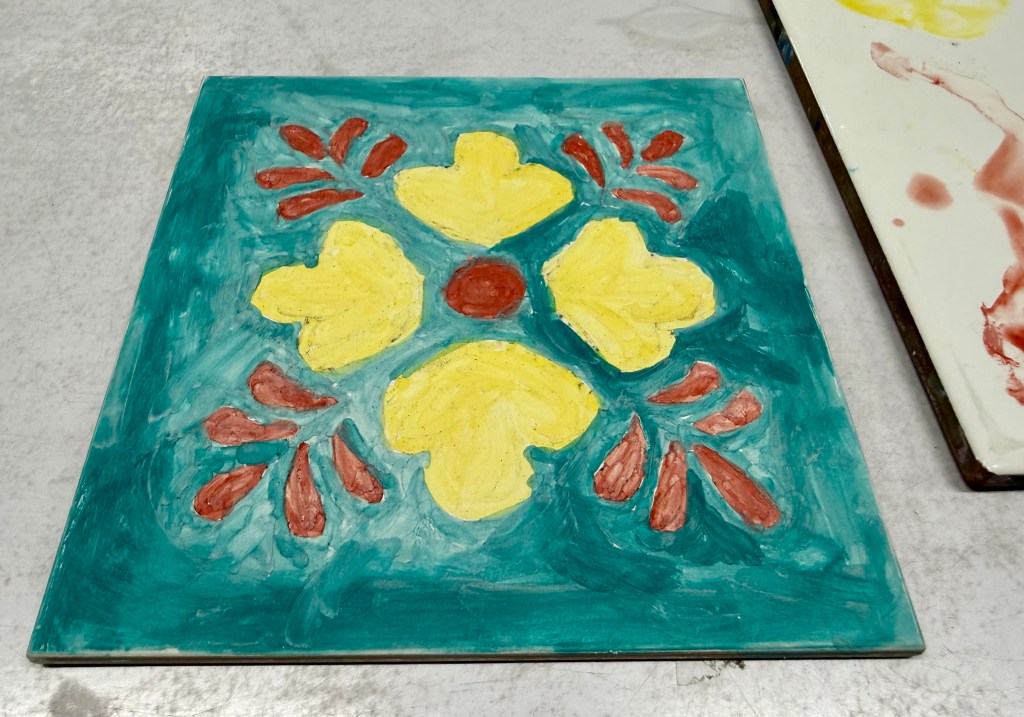
We practiced the Pisano and relief techniques. The other two participants produced elegant, delicate strokes on their Pisano tiles; mine leaned more toward “energetic” and “let’s get this done.” Watercolor skills, it turns out, do not materialize simply by being in Europe. Still, I had fun, thanks to Virginia, our patient and good-humored instructor.
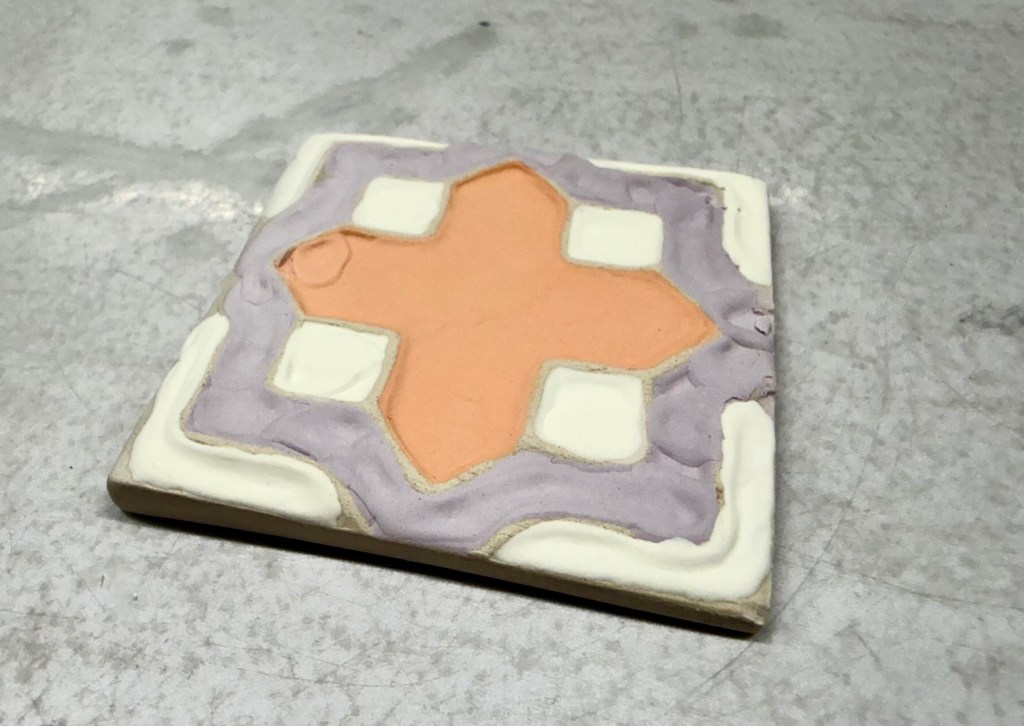
I’m more confident about my relief tile, where I kept the palette spare—blue, orange, and white—and let the raised lines do most of the work.
I wish I had taken this workshop earlier, before visiting the Alcázar, the Casa de Pilatos, and the Palacio de las Dueñas, where some of the city’s most extraordinary tiles are on display. I loved looking at them before; I just didn’t understand the history behind them—or how much patience and technique they require.
I pick up my two tiles tomorrow. We’ll see how they turn out.


 One month in Seville
Leave a reply to Jesus Conde Cancel reply